Reading a Poker Table: Button, Blinds, and Turn Order
Learn to read a poker table by tracking the button, blinds, and turn order, so you can follow each decision without losing your place.
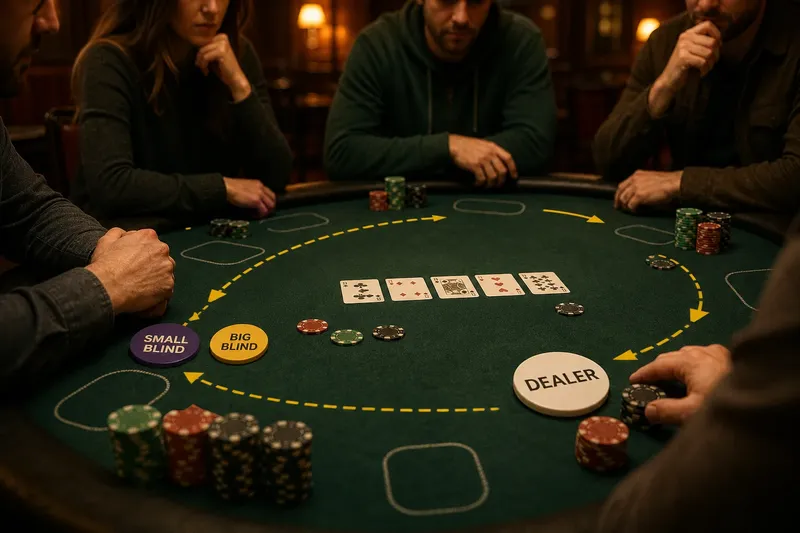
To read a poker table, track the dealer button, the blinds, and whose turn it is. In a typical Texas hold’em game, the button marks a position rather than the person physically dealing, and it helps set the order of action.
This map is useful for following a hand even if you do not know the players’ strategies. Other poker games can change the details, so use the table’s posted rules or ask the dealer when a procedure is unclear.
Where does the dealer button move?
Look for a round disk marked “dealer” or “button” in front of a player. In a casino, a house dealer usually handles the cards and chips; the button marks the dealer position for that hand.
In the usual procedure, the button advances one seat clockwise after each hand, whether or not that seat’s player is still in the game. If the next seat is vacant or a player has left, the room’s rules determine how the button and blinds are handled. Tournaments may use a dead-button procedure or another adjustment, so the marker does not always appear to pass neatly from one occupied seat to the next.
At a glance, identify the button, the small blind, the big blind, and the current action. Think of the button like a bookmark: it marks a place in the sequence, while the action itself moves from player to player.
What do the blinds tell you?
The small blind and big blind are forced bets posted by the players immediately to the button’s left. The small blind is next to the button, followed by the big blind.
These bets create an initial pot. A posted blind counts toward that player’s contribution for the betting round, but if the current bet is higher, the player generally needs to add chips to call.
Before the flop, the first player to act is usually the player to the big blind’s left, often called “under the gun.” Action then proceeds clockwise. If the action reaches the big blind without a raise, that player may check or raise under typical hold’em rules; if someone has raised, the big blind must respond to the new amount.
After the flop, turn, and river, the first player to act is generally the first player still in the hand, starting immediately to the left of the button and proceeding clockwise. The button itself does not move to a different seat during the hand. If the player in the small blind has folded, skip that seat and continue to the next player who remains in the hand. When the button’s holder is still involved, that player is usually last to act on these post-flop rounds.
How does action move around the table?
A betting round is also called a street. Players act pre-flop before the community cards are dealt; the flop brings the first group of community cards, and the turn and river add cards on later streets.
On a turn, a player chooses among the actions allowed by the current situation:
- Check: Pass without betting when no bet is facing the player.
- Bet: Make the first wager of the round when no one has bet yet.
- Call: Match the current bet.
- Raise: Increase the amount other players must match to continue.
- Fold: Give up the hand and stop contesting the pot.
After a bet, a player generally cannot check; they must call, raise, or fold, subject to the game’s rules and their available chips. If everyone but one player folds, the remaining player wins the pot without showing a hand. If at least two players remain after the final betting round, the hand reaches a showdown.
How can you keep track of a hand?
Follow the sequence: locate the button, find the blinds, identify the first pre-flop player, and then track each action. Skip players who have folded; they have no further decisions in that hand.
Say you are watching an invented hold’em hand with six occupied seats. Maya has the button, and the players to her left post the small and big blinds. The player immediately left of the big blind acts first pre-flop. After the flop, start again with the first player still in the hand to the left of Maya; if Maya has not folded, she will usually act last on that street. The observable cue is whose turn it is after each fold, call, or raise—not whether a seat remains occupied.
Listen for common table phrases. “Action is on you” means it is your turn. “On the button” refers to the player holding the marker or that position, while “in position” usually means acting later than an opponent in a betting round.
Which poker table terms should you recognize?
What does “under the gun” mean?
“Under the gun” is usually the first position to act pre-flop, immediately to the left of the big blind. Several players may still act afterward, so the position faces a different sequence of decisions from a player closer to the button.
What does “on the button” mean?
“On the button” means holding the dealer marker or occupying that position. The button is usually last to act after the flop, turn, and river when its holder remains in the hand, but pre-flop action begins to the left of the big blind.
What does “the blinds are live” mean?
A live blind can count toward its player’s action when the betting round reaches them, subject to the table’s rules. In a typical hand, the big blind can check if no one raises or respond to a raise by calling, raising, or folding.
What does “action is closed” mean?
Action is closed when each player still in the hand has had a chance to respond to the latest bet or raise. A later raise may reopen action under the applicable rules, giving players who already acted another decision.
What changes in tournaments and other formats?
Button and blind positions provide a useful map across many poker games, but betting structures differ. No-limit games let a player wager up to their available chips, limit games constrain bet sizes according to the structure, and pot-limit games set the maximum in relation to the pot.
Tournaments may use a dead button or another adjustment when a seat is vacant or a player leaves. Home games may use a rotating dealer instead of a house dealer. If you are playing, ask how that table handles vacant seats, the button, and betting rules.
What should you check before following the action?
- Check which seat has the button; if it advanced one seat clockwise, use that seat as the positional reference, but if a seat is vacant or the movement seems unusual, ask the dealer about the table’s procedure.
- Check who posted the small blind and big blind; if both positions are clear, use them to identify the first pre-flop player, but if a blind is missing or adjusted, confirm the house rule.
- Check the current street; if the hand is pre-flop, start with the player left of the big blind, but if community cards are out, start with the first active player left of the button.
- Check whether each player has folded, called, bet, or raised; if a player has folded, skip that seat, but if a bet or raise has changed the amount to match, wait for the next player to respond to it.
- Check whether you are certain it is your turn; if the dealer or action makes that clear, take only a legal action, but if the order is uncertain, pause and ask rather than acting out of sequence.
- Check whether the button’s holder is still in the hand after the flop; if so, that player is usually last to act on the street, but if they have folded, continue clockwise to the last remaining player who has not yet acted.
Once you can read the poker table’s button, blinds, and turn order, each decision becomes easier to place. Keep the vacant-seat rule in mind: the button normally advances by seat, not by searching for the next player still in the hand, while the order of action skips anyone who has folded.