How Faro Became a Public Gambling-Room Game
See how Faro’s public tables shaped its gambling-room image, and learn what a visible layout could—and could not—tell players and spectators.
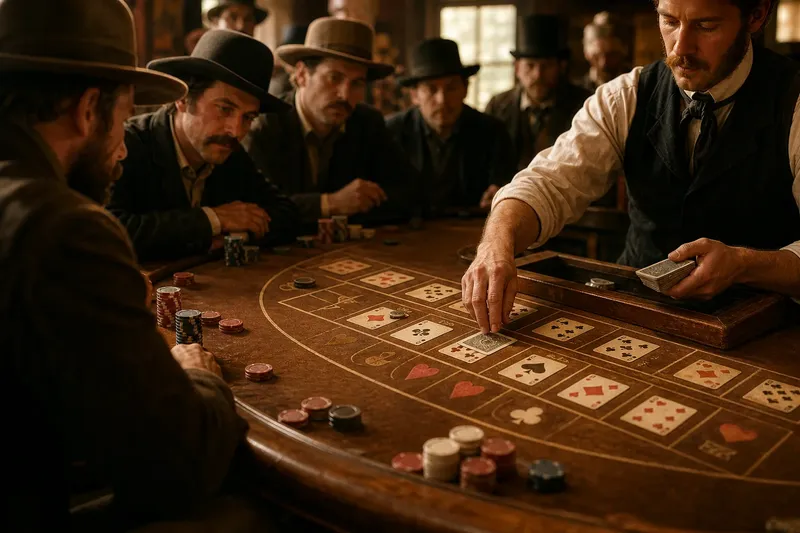
Faro’s marked table made the action easy to watch, but it did not make every gambling room alike. In the familiar image of Faro, a dealer manages the cards while players gather around a layout showing where wagers belong.
That public arrangement helps explain Faro’s cultural image without treating a storybook saloon as a record of every venue. The table supplied a visible routine; the room’s customs shaped how people watched, talked, and took part.
How did a public Faro table work?
Faro used a standard deck, a dealer or banker, and a layout marked with card ranks. Players placed wagers on ranks, and the dealing sequence determined which bets won or lost. The dealer managed the cards while players followed the rules of that particular table.
At a public table, the layout showed where wagers belonged, and the dealer provided a visible point of contact. It worked a little like a clearly labeled counter: the markings could show where an exchange happened, even if a newcomer still needed someone to explain the procedure.
A familiar layout did not settle every question. A crowded saloon and a quieter gaming room might have different customs, so visitors could not safely assume that one venue’s instructions applied elsewhere.
What could a spectator learn by watching?
From nearby, a spectator could see players place wagers on card ranks and watch the dealer carry out the dealing sequence. It was possible to recognize when a result had been settled without taking a seat, though finer rules might still need explanation.
Watching also gave a glimpse of the room’s habits: where people stood, how they addressed the dealer, and when they asked questions. The crowd could add conversation and shared reactions, but it could not influence the cards or make the next outcome predictable.
Imagine a traveler with no experience of Faro standing behind the chairs. The traveler watches one dealing sequence, asks which marked spaces correspond to card ranks, and then follows where the wager is settled. The visible result is a better understanding of that table’s routine, not an advantage over chance.
How should a newcomer read a Faro table?
Before wagering, a newcomer can observe a full sequence and ask the dealer or attendant about the room’s rules. These checks help distinguish what is visible from what still needs explanation:
- Look for the marked ranks and wager areas; if their purpose is clear, follow the layout, but if not, ask before placing anything.
- Ask when wagers may be changed; if the timing is explained plainly, decide whether you understand it, but if not, keep watching or step away.
- Ask who handles the cards and settles wagers; if responsibilities are clear, address the right person, but if not, do not assume another player speaks for the table.
- Ask whether there are rules beyond those shown on the layout; if they are explained clearly, decide whether you are comfortable with them, but if not, decline to wager.
- Check whether you can see the dealing sequence; if you can follow it, continue observing, but if your view is blocked, move to a permitted spot or ask for an explanation.
- Notice whether you are being invited to watch or wager; if the distinction is clear, choose freely, but if someone pressures you or blurs the terms, leave the table.
Say you enter a crowded saloon where a Faro game is underway. You watch one full sequence without wagering, then ask the attendant where bets go and when they may be changed. If the attendant points to the rank layout and explains the timing, you can decide whether the procedure makes sense to you; if the answer stays vague, keep watching or leave without betting. The decision follows the room’s stated rules, not a prediction about the next card.
Why did Faro fit a public room?
The dealer handled the cards, players watched their wagers, and each sequence produced a visible result. Much of the action could be followed from the edge of the table, so people could gather without all taking part in the same way.
Some visitors wagered; others watched, talked, or learned the layout. Their reasons for being there could differ, even as they shared the same room.
This helps explain Faro’s social character more precisely than calling it a crowd-pleaser. The dealer’s routine organized play, while the surrounding room supplied conversation, observation, and local customs.
How did Faro acquire its gambling-room image?
Faro is associated in popular portrayals with saloons and frontier gambling, but that image is not a complete account of every place and period in which the game was played. A scene in a story cannot establish how every table operated, and venues could differ.
The table itself offered a practical arrangement: marked ranks indicated where wagers went, and the dealer managed the dealing sequence. The public room gave visitors a place to observe the routine and encounter the game outside a private circle.
Keeping the game’s visible procedure separate from its familiar fictional setting makes its cultural role easier to describe. The rules made play possible; each venue shaped how people saw and discussed it.
What do readers ask about Faro’s public life?
Was Faro only played in public gambling rooms?
No. Faro could be played in private or informal settings as well as at public tables. Its association with gambling rooms describes a visible setting, not the only way people encountered the game.
Why did saloons feature Faro?
The layout and dealing action could be watched from nearby, allowing visitors to follow the basic sequence without taking a seat. Local venues varied, so a table’s presence does not establish that every room followed the same customs.
Could spectators affect a Faro result?
No. A spectator might learn how a particular table operated or join the room’s conversation, but watching did not change the cards or settle a wager.
Is Faro commonly played in casinos today?
The article’s historical and cultural focus does not establish how often Faro appears in contemporary casinos. A reference to the game may concern a historical portrayal, a discussion of its rules, or a particular event; check the context rather than assuming it describes routine casino play.
What does Faro’s public history help explain?
Faro’s public history shows how a venue can shape the social meaning of a game. A marked table made the procedure visible, while the room brought together players, observers, and customs specific to that setting.
For readers considering a Faro reference, the useful distinction is between what a crowd makes visible and what it cannot control. A busy table may show how people gathered around a game, but it cannot tell you whether a wager suits you or what card will appear next.